

Most trips begin with a simple plan: take a break and relax.
Then somebody opens a travel app.
Suddenly, your relaxing three-day holiday has eighteen attractions, four cafés, two sunrise points and a market located on the opposite side of the city.
You wake up earlier than you do for work, eat breakfast while checking the time and spend most of the day saying, “We need to leave now.”
By the end of the trip, you have photographs of every famous place—but very little memory of actually enjoying any of them.
Maybe the problem is not the destination.
Maybe we are simply trying to do too much.
When a Holiday Starts Feeling Like an Assignment
A packed itinerary looks impressive before the trip.
Day 1 has six places. Day 2 has another seven. Every meal is planned, every hour is occupied and there is absolutely no space for traffic, rain, tiredness or human emotions.
Then reality arrives.
The hotel takes longer to find. One friend needs breakfast. Another person wants to shop. The cab gets delayed and everybody spends fifteen minutes deciding where to eat.
Now the entire schedule is running late, and the group begins rushing through attractions just to say they visited them.
You reach a beautiful fort, take three quick photographs and immediately leave for the next location.
Technically, you saw the fort.
Emotionally, you mostly saw the parking area.
What Slow Travel Actually Means
Slow travel does not mean spending one month in every destination or doing absolutely nothing.
It simply means giving yourself enough time to experience a place without constantly checking the next item on your list.
Instead of covering five neighbourhoods in one day, explore one or two properly. Walk around, eat somewhere local and notice what everyday life looks like.
Stay at a viewpoint after taking the photograph. Sit beside the river without immediately creating a reel. Visit a market without turning it into a speed-shopping competition.
The aim is not to travel slowly for the sake of it.
The aim is to be mentally present while travelling.
You Notice More When You Stop Rushing
When your schedule is not packed, small details begin to appear.
You notice the old houses beside the market, the smell coming from a bakery, children playing in a lane and the shopkeeper who has been selling tea from the same corner for years.
These moments may never appear on a “Top 10 Things to Do” list, but they often become the memories you talk about later.
Nobody returns home saying, “My favourite part was successfully completing all seventeen itinerary items.”
They remember the unexpected café, the conversation with a local driver or the evening when the group sat together and laughed without doing anything special.
You Can Actually Taste the Food
Food is one of the easiest ways to understand a place, but a rushed itinerary rarely leaves enough time for it.
You order quickly, eat quickly and leave because another attraction closes in forty minutes.
Slow travel allows you to have breakfast without treating it like a pit stop. You can ask for a local recommendation, try a dish you have never heard of or return to the tea stall you liked the previous evening.
Not every meal needs to happen inside a famous restaurant.
Sometimes the best food experience is a simple plate served at a busy local shop where nobody is worried about creating an aesthetic presentation.
The food arrives, it tastes excellent and your phone remains in your pocket. Beautiful.
Your Plans Have Space to Change
Travel rarely follows the exact plan.
The weather changes. A road closes. Somebody falls asleep. A place looks less interesting in reality, while another unexpected location deserves more time.
A flexible itinerary allows you to adjust without feeling that the entire trip has been ruined.
If it begins raining, you can spend the afternoon in a café or museum. If you love a particular beach, you can stay until sunset instead of leaving because a spreadsheet says the next activity begins at 4:15.
Good planning helps a trip.
Overplanning starts controlling it.
You Spend Less Time in Traffic
One of the biggest mistakes travellers make is choosing attractions only by popularity and not by location.
A place may look close on the map but still take an hour to reach because of traffic, road conditions or mountain routes.
When you select fewer places and group nearby attractions together, you spend more time exploring and less time staring through a cab window.
This also reduces transport expenses and the daily argument about who will book the next ride.
A holiday should include journeys, but it should not become one continuous commute.
Slow Travel Can Be Better for Group Trips
Every person in a group has a different energy level.
One friend wants to wake up for sunrise. Another wants to sleep until breakfast ends. Somebody enjoys museums, while somebody else considers a shopping market an important cultural experience.
A packed itinerary makes these differences more difficult to manage because every delay affects the entire day.
A slower plan gives people room to make choices.
Some friends can visit an attraction while others relax at the hotel. The group can meet later for lunch without turning the decision into a national-level discussion.
Travelling together does not mean everybody must follow the same schedule every minute.
You Return Feeling Rested
Many people need a recovery day after their holiday.
Sometimes this is unavoidable, especially after long journeys. But often, it happens because the trip was more exhausting than everyday life.
You woke up early, walked continuously, travelled across the city and slept late because nobody wanted the night to end.
Then you returned home carrying laundry, hundreds of photographs and a strong desire for another break.
Slow travel gives your body and mind some breathing space.
A relaxed morning, an unplanned afternoon or an early night does not mean you wasted your trip. Rest is also part of the experience.
You are allowed to enjoy the hotel room you paid for.
But What About Missing Famous Places?
This is where travel FOMO enters.
You worry that you may never return, so you try to see everything in one visit.
The truth is that you will always miss something.
Every destination has another street, restaurant, viewpoint or nearby town that you could have explored. No itinerary can include everything.
Instead of asking, “How many places can I cover?” ask, “Which experiences matter most to me?”
Choose a few important attractions and give them proper time. If something remains, it becomes a reason to return—or simply a place you did not visit.
Missing one monument will not cancel your entire holiday.
How to Plan a Slower Trip Without Wasting Time
Slow travel still benefits from basic planning.
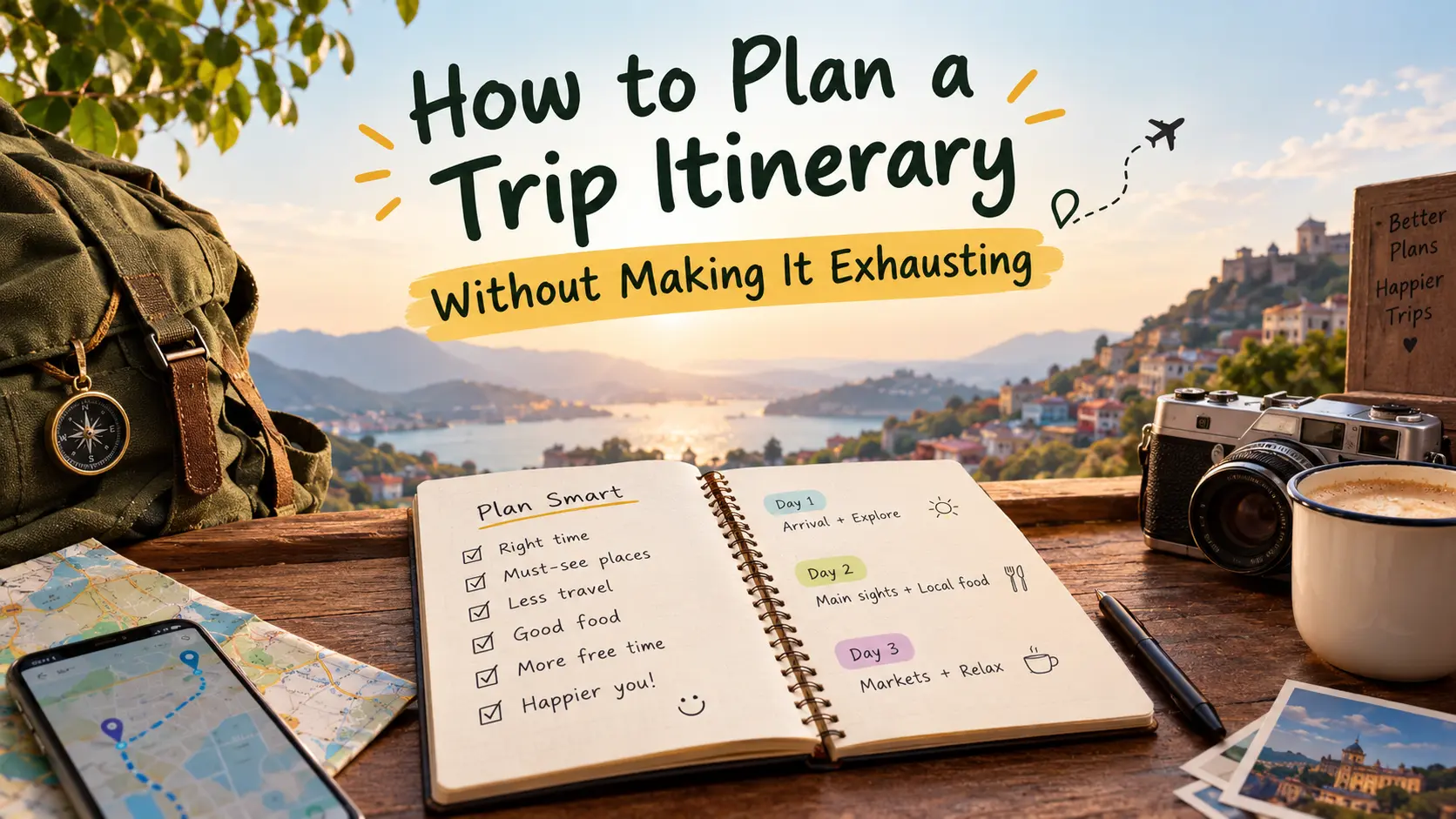
Select two major activities per day
Keep one main activity for the morning and another for the afternoon or evening. Add smaller stops only when they are nearby and you still have the energy.
Group places by area
Explore one part of the destination at a time. Avoid travelling from one end of the city to another repeatedly.
Keep one part of the day free
A free evening or afternoon gives you space for rest, shopping, an unexpected recommendation or a plan delayed by weather.
Stay in a convenient location
A slightly more expensive hotel near the areas you want to explore may save time and daily transport costs.
Ask what the group genuinely wants
Do not add a place only because it is famous. If nobody is interested, you are allowed to skip it.
Stop treating rest like failure
Sitting in a café, walking without a destination or watching the sunset is not wasted time.
It is often the part that makes the trip feel like a holiday.
Record the Moments Between the Attractions
Travel memories are not limited to monuments and viewpoints.
The train conversation, roadside breakfast, wrong turn, sudden rain and peaceful hotel balcony can become equally important parts of your story.
When you record your journey on Jyurniq, include these smaller moments too. Add the places you discovered accidentally, the food you loved and the part of the day when nothing was planned.
Years later, those details may help you remember the trip more clearly than another perfectly posed photograph.
You Do Not Need to Complete a Destination
A destination is not a syllabus.
You do not receive additional marks for visiting every attraction, and nobody is going to check whether you completed all the recommended activities.
Travel is not about proving how much you covered.
It is about how deeply you experienced whatever you chose to see.
So, on your next trip, leave one afternoon empty. Stay longer at the place you love. Order another cup of tea. Let the plan change.
You may return with fewer photographs and a shorter list of attractions.
But you will probably return with a better story.


Conversation
0 comments