
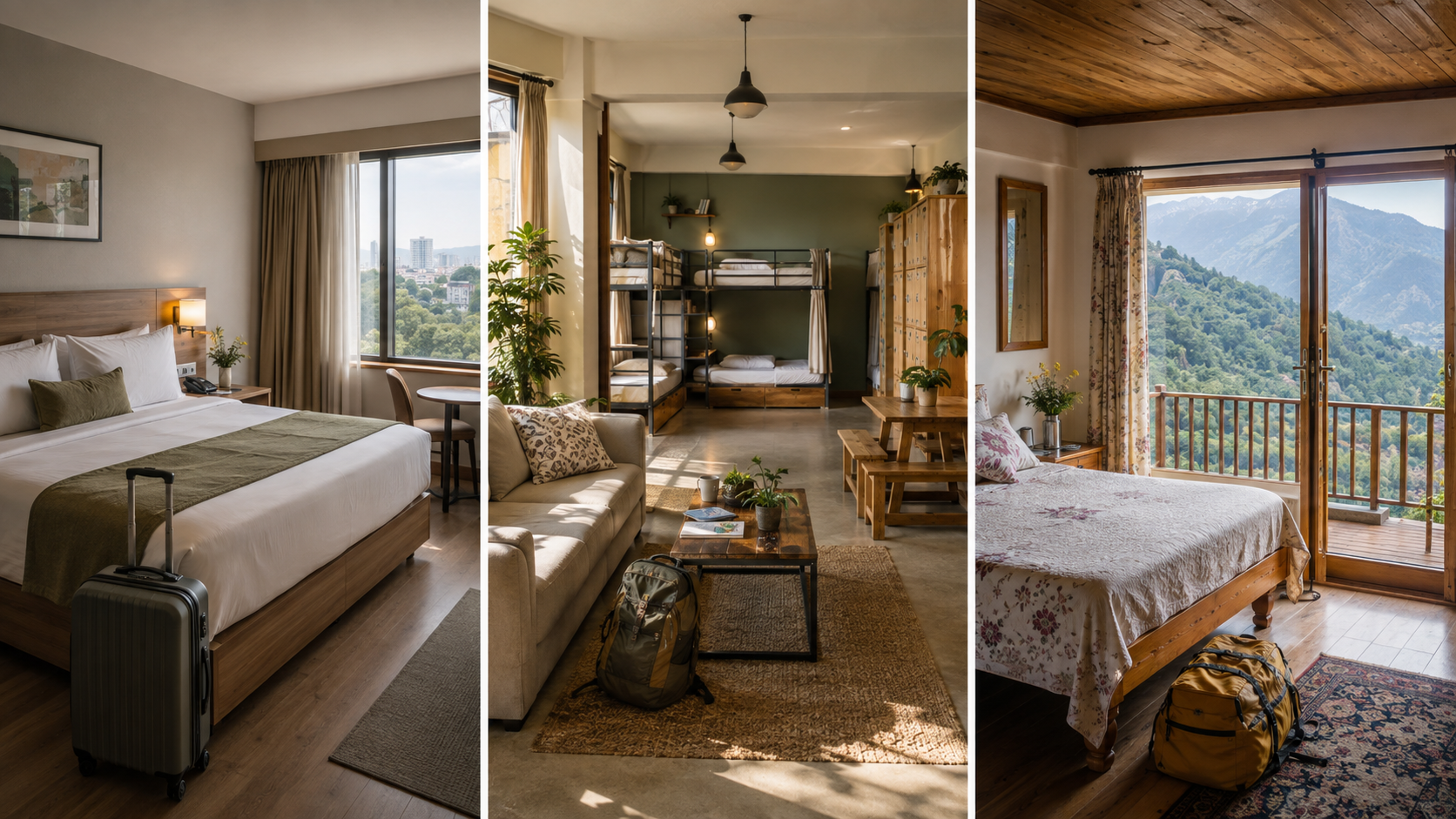
A beautiful destination can easily be spoiled by uncomfortable accommodation.
The room does not need to be luxurious, but it should be clean, safe and conveniently located. After spending the day exploring, your accommodation becomes the place where you rest, organise your belongings and prepare for the next adventure.
Hotels are not the only option anymore. Depending on your destination, budget and travel style, you can choose from hostels, homestays, resorts, guesthouses, apartments and even houseboats.
Here is how each option is different, and how you can choose the right place for your trip.
1. Hotels – The Convenient and Familiar Choice
Hotels are usually the easiest option for travellers who want privacy, regular housekeeping and straightforward service.
They are available across different budgets, from simple rooms to premium properties. Many hotels also provide breakfast, room service, luggage storage and a reception desk that remains available for most of the day.
A hotel works especially well for short trips when you want a smooth check-in process and do not plan to spend much time inside the property.
Before booking, check whether taxes, breakfast and extra-person charges are included in the displayed price.
Best for: Families, short trips, work travel and travellers who value privacy.
2. Hostels – Affordable and Social
Hostels are popular among solo travellers and groups looking for affordable accommodation.
Most hostels offer shared dormitories, although many also have private rooms. Common spaces allow guests to interact, exchange travel tips and sometimes participate in organised activities.
Shared rooms are economical, but they may not suit everyone. You should be comfortable sharing sleeping and bathroom areas with other guests.
Check whether the hostel provides individual lockers, secure access, clean washrooms and separate room options where required. Read recent reviews carefully, especially comments about cleanliness, noise and staff availability.
Best for: Adult solo travellers, backpackers and groups travelling on a limited budget.
3. Homestays – A More Local Experience
A homestay allows you to stay in a local family’s property or in a guest area managed by the owners.
These stays often feel warmer and more personal than regular hotels. Hosts may suggest less-crowded attractions, arrange homemade meals or help you understand the local culture.
Homestays are especially enjoyable in hill stations, villages, plantations and smaller towns. However, facilities can vary widely. Some feel similar to boutique hotels, while others offer a simple room inside a family home.
Read the complete description and check whether meals, private bathrooms, heating, parking or transportation are available.
Best for: Slow travel, families and travellers interested in local culture.
4. Resorts – When the Stay Is Part of the Holiday
A resort is not just a room for the night. The property itself is usually an important part of the experience.
Resorts may include gardens, pools, restaurants, indoor games, guided activities or direct access to a beach, forest or scenic viewpoint. They can be useful when you want a relaxed holiday without travelling to multiple attractions every day.
However, resorts are often located outside the main town. Check transportation options before booking and confirm whether meals and activities are included in the rate.
A low room price can become expensive if every meal, activity and transfer is charged separately.
Best for: Relaxing family holidays, celebrations and trips where you want to spend time at the property.
5. Guesthouses – Simple, Comfortable and Often Affordable
Guesthouses are generally smaller than hotels and may be managed directly by an individual or family.
They usually offer fewer services, but the rooms can be clean, comfortable and reasonably priced. Because there are fewer guests, the atmosphere may feel quieter and more personal.
A guesthouse is a good choice when you need a safe place to sleep but do not require room service, a gym or other hotel facilities.
Check the reception hours, payment options and check-in process before arriving, especially if you expect to reach late.
Best for: Budget trips, longer stays and travellers who prefer smaller properties.
6. Apartments and Vacation Rentals – Useful for Groups and Longer Trips
A serviced apartment or vacation rental gives you more space than a typical hotel room.
These properties may include multiple bedrooms, a living area and a kitchen. For families or groups, sharing one apartment can be more affordable than booking several hotel rooms.
Access to a kitchen also helps when you want to prepare simple meals or have specific food requirements.
Before booking, verify the property’s location, check-in process, security and cleaning charges. Make sure the listing clearly explains who manages the property and how you can contact them if a problem occurs.
Best for: Families, groups and longer stays.
7. Unique Stays – Houseboats, Tents and Heritage Properties
Sometimes the accommodation becomes the strongest memory of the entire trip.
You might stay on a houseboat in Kerala, inside a restored heritage property in Rajasthan or in a responsibly managed campsite surrounded by nature.
Unique stays can be memorable, but the experience may be different from a normal hotel. Internet access, electricity, hot water or transportation might be limited in remote locations.
Check safety standards, weather conditions and accessibility before booking. For outdoor stays, use established operators and avoid isolated or unauthorised campsites.
Best for: Special trips and travellers who want an experience beyond a standard hotel room.
How to Choose the Right Location
A beautiful property is not helpful if it is too far from everything you want to explore.
Before booking, mark the accommodation and main attractions on a map. Check the distance from railway stations, bus stops, airports, restaurants and medical facilities.
For a short trip, staying centrally may be more convenient. For a relaxed holiday, a quieter property outside the city may be worth the additional travel.
Do not depend only on descriptions such as “near the market” or “minutes from the beach.” Always check the actual location.
What to Check Before Booking
Read the full listing instead of deciding only from the photographs.
Look for:
Recent reviews from verified guests
Cleanliness and bathroom condition
Exact location and transportation options
Reception and check-in timings
Cancellation and refund policies
Final price after taxes and additional charges
Availability of Wi-Fi, parking, heating or air conditioning
Breakfast and meal arrangements
Secure locks, lockers and staff availability
Age and identification requirements
Travellers under 18 may face booking restrictions at many properties and should travel with a parent, guardian or responsible adult while confirming the property’s policy in advance.
Do Not Trust Photographs Alone
Property photographs are usually taken in the best lighting and from angles that make rooms appear larger.
Guest photographs often give a more realistic idea of the room, bathroom, view and surrounding area. Recent reviews can also reveal whether the property is currently being maintained properly.
Pay attention to repeated complaints. One negative review may be an individual experience, but several guests mentioning the same problem should not be ignored.
Cheapest Does Not Always Mean Best Value
A very cheap room may come with additional transportation costs, poor cleanliness or limited facilities.
At the same time, an expensive hotel is not automatically the best choice. You may be paying for facilities you will never use.
Compare the complete value: location, safety, comfort, included meals, services and cancellation flexibility.
The right accommodation is the one that meets your actual needs, not necessarily the cheapest or most luxurious option.
Final Thoughts
Your place to stay shapes a large part of your travel experience.
Choose a hotel when you want convenience, a hostel when affordability and community matter, a homestay for local warmth or a resort when relaxation is the main purpose of the trip.
Whatever you select, prioritise safety, cleanliness and location. A comfortable stay gives you the energy to enjoy the destination instead of spending the journey worrying about your room.
Conversation
0 comments